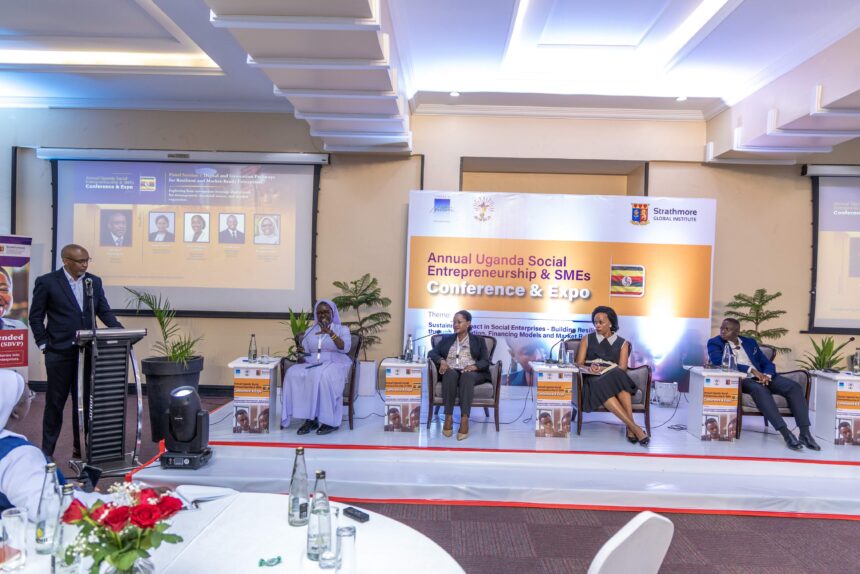
Reliable financial records, sound governance and digital transaction histories are increasingly becoming critical for small and medium-sized enterprises (SMEs) seeking financing, as lenders place greater emphasis on evidence of business performance and repayment capacity.
At the Annual Uganda Social Entrepreneurship and SMEs Conference and Expo held in Kampala recently, financial sector leaders said many businesses struggle to secure financing not necessarily because capital is unavailable, but because they cannot provide credible records showing their financial position and ability to repay loans.
Mabel Ndawula, Executive Director of dfcu Foundation, urged entrepreneurs to assess their businesses from a lender’s perspective, paying attention to cash flows, financial records and governance structures.
She said businesses must demonstrate consistent cash flows and the capacity to meet their financial obligations before lenders can confidently extend credit.
“Businesses need to understand their numbers and be able to demonstrate them. Without reliable records, it becomes difficult to assess performance, plan for growth or give a lender confidence in the business’s ability to manage debt,” Ndawula said.
She encouraged entrepreneurs to strengthen financial literacy, comply with regulatory requirements, establish sound governance practices and separate personal finances from business accounts.
The discussion comes amid concerns about the sustainability of Uganda’s small business sector, which plays a significant role in employment and economic activity.
A 2026 policy brief by the Ministry of Finance, Planning and Economic Development estimates that the informal economy accounts for approximately 55% of economic activity, while informal employment represents about 92% of total employment.
Uganda’s Fourth National Development Plan indicates that the country has approximately 1.1 million micro, small and medium-sized enterprises employing more than 2.5 million people and accounting for about 90% of non-farm employment. However, more than 60% of these businesses reportedly close within their first five years.
The panel, which included aBi Finance Chief Executive Officer Mona Muguma Ssebuliba, Ensibuuko Chief Executive Officer Gerald Otim and Professor Dominica Dipio of the Missionary Sisters of Mary Mother of the Church, examined practical ways of improving business resilience and access to financing.
Otim challenged entrepreneurs to embrace digital record-keeping without assuming that the process requires expensive software or sophisticated technology.
He encouraged businesses to start with readily available tools, including mobile money platforms, digital merchant payment solutions and conventional banking channels, to document transactions and build reliable financial histories.
“Businesses do not need complex systems to begin their digital journey. What matters is creating records that provide a clear picture of performance and support better decision-making,” he said.
As lenders increasingly consider documented business performance when assessing credit applications, digital records can help entrepreneurs demonstrate revenue patterns, monitor cash flows and make more informed investment decisions.
Ndawula said the high rate of business failure highlights the need for stronger management practices and financial discipline among entrepreneurs.
She added that although financing remains essential for business expansion, SMEs must first establish the systems, skills and records needed to use borrowed funds effectively, manage risks and achieve sustainable growth.
Through its enterprise development programmes, business training initiatives and financial inclusion efforts, dfcu Foundation supports entrepreneurs in strengthening governance, financial management and business readiness.
Ndawula said reliable record-keeping remains one of the practical steps SMEs can take to improve decision-making, build credibility with lenders and investors, and position themselves for long-term growth.