By EW Reporter
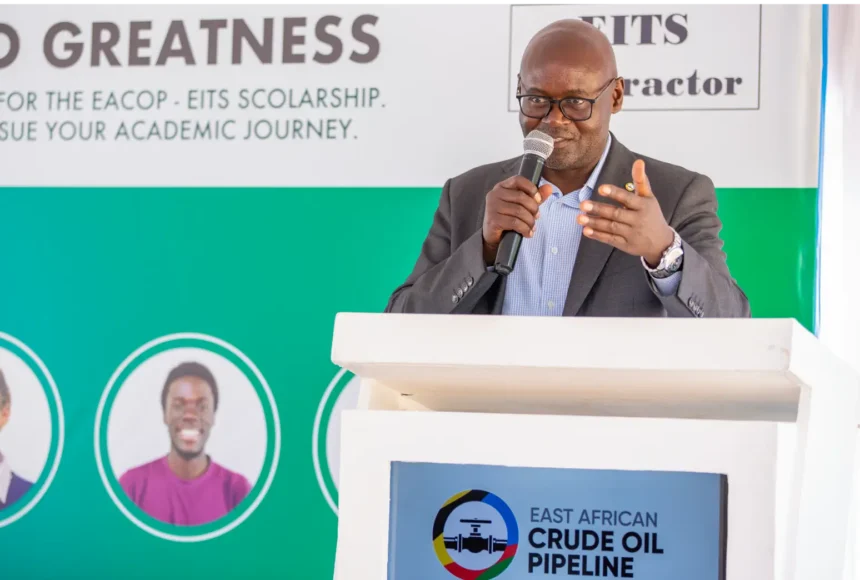
The East African Crude Oil Pipeline (EACOP) Ltd., in partnership with its Tier One Electrical, Instrumentation, Telecommunications and Security Systems (EITS) contractor, has launched a university scholarship programme to support 16 academically gifted but financially disadvantaged students pursuing science and technology-related courses, it said on Sept.4.
The beneficiaries, comprising 10 students from Kyambogo University pursuing Telecommunications Engineering and six from Makerere University studying Computer Science, will receive financial support to complete their university education.
The programme was launched in Kampala on September 4, 2026, and is the second scholarship initiative of its kind implemented under the EACOP project in Uganda.
EACOP said the programme reflects its commitment, together with its contractors, to creating lasting social and economic benefits beyond the construction and implementation of the pipeline.
The scholarship selection process was conducted through a competitive and transparent process that included interviews with shortlisted candidates from the two universities.
Selection was based on academic performance, demonstrated financial need, commitment to the chosen field of study and the potential to contribute positively to society.
Seven of the 16 beneficiaries are female, highlighting the programme’s contribution to increasing women’s participation in Science, Technology, Engineering and Mathematics (STEM) disciplines.
EACOP said the scholarship programme forms part of its wider National Content and skills development strategy, which seeks to ensure that Ugandans acquire skills and experience relevant to the country’s emerging oil and gas industry.
The company was established to develop, construct and operate the East African Crude Oil Pipeline, which will transport crude oil from Kabaale in Hoima, Uganda, to the Chongoleani Peninsula near Tanga in Tanzania for export to international markets.
Beyond developing the pipeline infrastructure, EACOP said it is focused on increasing the participation of local companies and professionals through the sourcing of local goods and services, skills development and knowledge transfer.
To support these objectives, EACOP and its contractors have entered into Memoranda of Understanding with a number of Ugandan professional bodies and educational institutions.
These include the Uganda Petroleum Institute Kigumba (UPIK), Makerere University, Kyambogo University, Nakawa Technical Vocational College and the Institute of Surveyors of Uganda.
The company said it is also engaging additional strategic institutions as it prepares for the operations phase of the project.
Through its capacity-building initiatives, EACOP and its contractors have hosted 127 interns and graduate trainees, providing young Ugandans with opportunities to gain practical experience and exposure to industry practices.
The company said these programmes are intended to help bridge the gap between university education and workplace requirements, particularly in technical fields associated with the oil and gas sector.
EACOP has also implemented a Train-the-Trainer initiative aimed at strengthening the capacity of lecturers, technicians and professors in tertiary institutions.
Under the programme, 808 hours of training have been delivered to teaching and technical staff.
The initiative is intended to strengthen national curricula by exposing educators to emerging technologies and industry practices informed by experience and lessons from the EACOP project.
EACOP said strengthening the capacity of educational institutions is important for ensuring that skills development continues beyond individual project interventions.
The company argues that stronger links between industry and academia can help educational institutions better prepare graduates for changing technological and labour-market requirements.
The scholarship, internship, graduate trainee and Train-the-Trainer programmes form part of EACOP’s broader effort to link the pipeline project to long-term human capital development.
The company said these initiatives are intended to ensure that the project contributes not only to infrastructure development but also to sustainable skills development and capacity building in Uganda and Tanzania.