How Dr Gladys Kalema-Zikusoka’s gorilla journey is turning a conservation memoir into a new invitation to discover Uganda
By News Correspondent
When visitors walk into the misty forests of Bwindi, they are not simply entering a national park. They are stepping into a story.
It is a story of rare mountain gorillas, ancient forests, surrounding communities and a country whose natural heritage has increasingly become one of its most powerful tourism assets.
Now, Uganda is finding another way to tell that story.
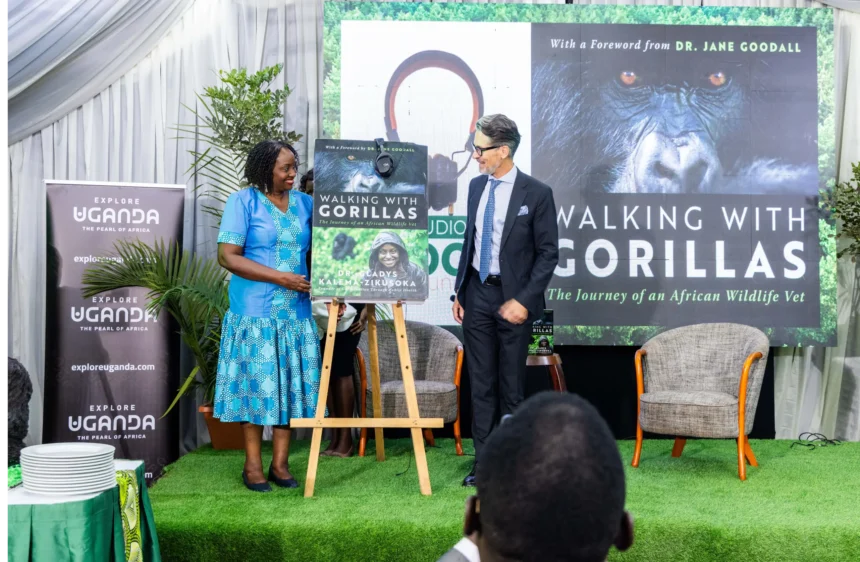
On Thursday, August 20, 2026, conservationist and Uganda’s first wildlife veterinarian, Dr Gladys Kalema-Zikusoka, stood before an audience of conservationists, tourism and hospitality players, diplomats and environmental enthusiasts at Sheraton Kampala Hotel to launch the audiobook version of her memoir, Walking with Gorillas.
Narrated by Kalema-Zikusoka herself, the audiobook gives her conservation journey a new voice and, potentially, gives Uganda another tool for selling itself to the world.
It is a simple idea with a powerful tourism proposition: before a traveller buys a ticket to Uganda, give them a reason to dream about the country.
For Kalema-Zikusoka, that journey began long before she became an internationally recognised conservationist.
As a student at Kibuli Secondary School, she established a wildlife club. Her fascination with animals eventually led her into veterinary medicine and, later, to a historic position as Uganda Wildlife Authority’s first wildlife veterinarian.
“When I was the first wildlife vet in UWA, no one used to touch animals, but now everybody is treating them, moving them,” she recalled at the launch.
But her experience with gorillas would teach her that protecting wildlife required more than treating animals.
The story behind the gorillas
One of the defining lessons of Kalema-Zikusoka’s career emerged from an encounter with disease affecting mountain gorillas.
Her experience showed her that the health of gorillas could not be separated from the health and livelihoods of people living around their habitat.
“You can’t protect the gorillas unless you engage the communities around them,” she said.
That realisation eventually led to the establishment of Conservation Through Public Health (CTPH) in 2003, an organisation built around a One Health approach linking human health, animal health and environmental conservation.
The model has since included community health, sanitation, family planning and livelihood initiatives around Bwindi.
CNN has also highlighted the model in its coverage of Kalema-Zikusoka, noting that CTPH’s Village Health and Conservation Teams now reach more than 10,000 households.
Her work has consequently turned the gorilla from simply being a wildlife attraction into a symbol of a much broader story about Uganda: conservation, community development, health, livelihoods and tourism. That story matters economically.
Tourism’s growing value
Uganda’s tourism sector has entered 2026 with stronger numbers than at any point since the Covid-19 pandemic.
According to the Ministry of Tourism, Wildlife and Antiquities’ latest 2025 tourism statistics, international tourist arrivals rose 19.7% to 1.64 million in 2025, while tourism receipts increased 21.3% to US$1.62 billion, equivalent to about Shs5.83 trillion. The sector had recovered to 106% of its 2019 level.
Tourism directly supported 876,512 jobs and accounted for 57.2% of Uganda’s service exports, according to the Ministry.
The latest figures build on a strong recovery in 2024, when Uganda received 1.37 million international visitors and earned about US$1.28 billion from international tourism.
The figures underline why tourism is no longer simply a leisure industry. It is a major foreign exchange earner, employer and source of business for hotels, restaurants, airlines, tour operators, transport companies, farmers, craft makers and communities around attractions.
And within that ecosystem, Uganda’s gorillas occupy a special position.
CNN reported in 2025 that Bwindi is home to almost half of the world’s remaining mountain gorillas, while tourism has helped bring greater protection to the species and its habitat.
For Uganda, therefore, the gorilla is not just an animal to be protected. It is also an ambassador for the destination.
Selling a destination through stories
This is where Walking with Gorillas acquires significance beyond being a memoir.
Kalema-Zikusoka said some people who read the book had become interested in visiting Uganda after learning about its gorillas.
“A lot of tourists have read my book even before they come to Uganda,” she said.
Some, she added, had initially considered travelling elsewhere but changed their minds after reading about Uganda’s mountain gorillas.
“When they read about the gorillas in Uganda, they say, ‘We have to come to Uganda,’” she said.
She now expects the audiobook to expand that audience.
“I know that through the audiobook, even more tourists will want to come and visit Uganda, see the gorillas and support the local efforts on the ground,” she said.
The strategy is increasingly relevant in a tourism industry where destinations compete not only on attractions, but also on the stories they tell about themselves.
Uganda has extraordinary wildlife, landscapes, cultures and historical sites. But an attraction alone does not necessarily make someone travel thousands of kilometres.
A compelling story can. A potential visitor may not initially know where Bwindi is. But they may remember the story of a young Ugandan woman who became the country’s first wildlife veterinarian, walked among mountain gorillas and discovered that saving them also meant improving the lives of their human neighbours. That emotional connection can turn curiosity into travel.
Hospitality tells its part
The tourism story is also being taken up by the hospitality industry.
At the audiobook launch, Sheraton Kampala Hotel unveiled Zongo, a wildlife mascot and conservation campaign inspired by Uganda’s mountain gorillas.
Jean-Philippe Bittencourt, General Manager of Sheraton Kampala Hotel, said the initiative reflects a broader understanding of the hospitality industry’s role in promoting the destination.
“Hospitality is about celebrating lives and other aspects of life. As a hotel, our service goes beyond offering hotel facilities,” he said.
Zongo is expected to feature in the hotel’s social media platforms, guest experiences and special events, alongside limited-edition collectibles.
A percentage of revenue from the collectibles will support CTPH’s mountain gorilla conservation work.
For a hotel, this creates a connection between the visitor’s experience in Kampala and the wildlife experiences that attract tourists to Uganda’s national parks.
It also demonstrates how tourism promotion can move beyond conventional advertising.
A hotel guest who encounters Zongo, hears about the gorillas and learns about the conservation work behind them becomes part of the story.
Conservation and communities
At the launch, Jan Sadek, Ambassador of the European Union to Uganda, reinforced another important dimension of the story: conservation cannot succeed without communities.
“People and gorillas are inseparable, so you have to care for both,” he said.
The EU has also committed €40 million to a forestry programme in Uganda aimed at tackling deforestation while supporting forest restoration, sustainable value chains, governance and community livelihoods.
The connection between conservation and livelihoods is particularly important for tourism.
A protected forest attracts visitors. Visitors create demand for accommodation, guiding, transport, food, crafts and cultural experiences. That economic activity can, in turn, give communities greater incentives to protect the resources that attract tourists in the first place.
The cycle only works, however, when communities see tangible benefits.
Kalema-Zikusoka’s work has sought to strengthen that link through initiatives such as community health programmes and Gorilla Conservation Coffee, which pays farmers a premium while directing support towards health, conservation and education.
A story with global reach
The audiobook launch also comes at a moment when Kalema-Zikusoka’s personal profile is expanding internationally.
In August 2026, CNN featured her as a CNN Hero, highlighting her pioneering conservation work and the connection she has established between the wellbeing of mountain gorillas and their human neighbours.
That international visibility gives Uganda an additional opportunity.
When a globally recognised conservationist tells her story, she is also telling the story of the country where that work happened.
Walking with Gorillas therefore becomes more than an account of one woman’s career. It becomes a piece of destination marketing, albeit one built around authenticity rather than conventional advertising.
Uganda’s challenge now is to multiply such stories.
The country needs more Ugandan writers, filmmakers, photographers, conservationists, tour guides and communities to tell compelling stories about its landscapes, wildlife, culture and people.
Kalema-Zikusoka encouraged Ugandans to write and narrate their own stories, arguing that local voices can become powerful tools for promoting the country internationally.
For a sector seeking to grow tourism earnings, increase visitor numbers and persuade tourists to stay longer, such storytelling could be an important part of the strategy.
The numbers show that Uganda’s tourism recovery is already gathering pace. But the next stage will require turning attractions into experiences and experiences into stories that people around the world can discover, remember and ultimately follow to Uganda.
As the final voice of the audiobook fades, the message from Kalema-Zikusoka’s journey remains clear: Uganda’s wildlife is not merely something the world can come to see.
It is a story the world can be invited to experience.
And if that story is told well, it can help bring more visitors to Uganda, create more opportunities for communities and strengthen the economic case for protecting the natural heritage on which the country’s tourism future depends.