

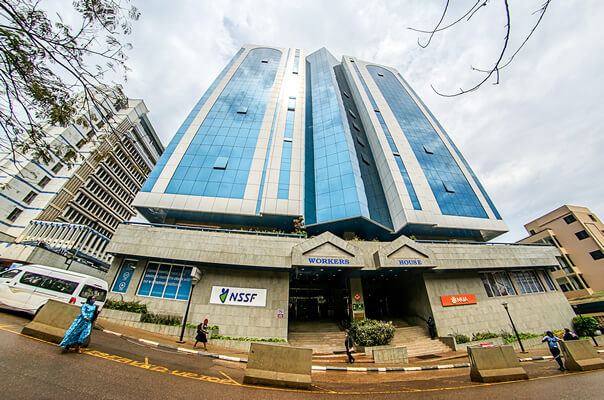
The National Social Security Fund’s (NSSF) decision to credit members with a record 22.53% interest rate may already have slipped from the headlines, but its significance is only beginning to emerge.
The rate, announced on September 24 by Finance Minister Henry Musasizi for the financial year ended June 30, 2026, is not simply another annual return to be celebrated and forgotten. It provides a window into how Uganda’s largest social security fund is investing workers’ money, how much value long-term saving can create and, importantly, why members should not assume that this year’s exceptional return will automatically be repeated.
The 22.53% rate is the highest declared by NSSF in its 40-year history. It compares with 13.5% for the previous financial year and the previous high of 15% recorded in 2017/18. According to NSSF’s 2026 Integrated Report, the latest rate translates into Shs5.44 trillion being credited to members, compared with Shs2.78 trillion in the previous year. (Monitor)
That difference is substantial.
A member with a Shs10 million qualifying balance, for example, would see about Shs2.253 million added at a 22.53% rate, before considering contributions, withdrawals and the precise balance used in the Fund’s calculation.
But the more important question for members is what produced such a sharp increase and whether it changes the long-term retirement picture.
Source of the money
NSSF’s assets grew from Shs26.01 trillion in the 2024/25 financial year to Shs32.87 trillion by June 2026, representing growth of about 26%. The Fund’s realised income also increased significantly, while its investment portfolio continued to be dominated by fixed-income securities. (NSSF Integrated Report 2026)
NSSF’s figures show that fixed-income investments stood at about Shs24.7 trillion, equities at Shs5.9 trillion and real estate at about Shs1.56 trillion at the end of the financial year. The equity portfolio benefited from both additional investments and rising share prices in several regional companies. (NSSF Integrated Report 2026)
The Fund’s investment strategy therefore matters to every member. NSSF is not simply collecting 15% of an employee’s salary and keeping the money aside. Under Uganda’s mandatory contribution arrangement, the employee contributes 5% of salary while the employer contributes 10%, after which the Fund invests the accumulated savings.
The result is that retirement savings become an investment pool whose performance can materially affect the eventual value available to members.
NSSF has said its investment approach is designed for the long term, with fixed income providing relatively predictable cash flows while equities and other assets provide opportunities for capital growth.
The inflation question
The 22.53% figure becomes even more significant when placed against Uganda’s current cost of living.
The Uganda Bureau of Statistics reported annual headline inflation of 4.1% in August 2026, up from 4.0% in July. Core inflation stood at 3.5%. (UbOS)
That means the latest NSSF return was substantially above the prevailing annual rate of price increases.
However, members should distinguish between one exceptional annual return and the long-term objective of preserving purchasing power.
NSSF has previously stated that its investment objective is to earn returns that outperform the average inflation rate over the long term. The Fund’s latest performance therefore matters not because 22.53% becomes the new expectation, but because sustained returns above inflation determine whether retirement savings retain their purchasing power over decades. (Monitor)
Beyond the 22.53% interest rate
There is another reason the latest announcement deserves a second look.
NSSF Managing Director Patrick Ayota has urged members to think long-term rather than treating retirement savings as money to be accessed whenever immediate financial pressure arises. The Fund has repeatedly positioned its savings as a financial cushion for retirement and other qualifying benefits. (Monitor)
This is particularly relevant in an economy where households face competing demands for school fees, healthcare, housing, business capital and other expenses.
The temptation to focus on today’s needs can make long-term retirement saving appear less urgent. Yet the power of a pension fund lies precisely in the length of time over which contributions and investment returns accumulate.
The latest figures demonstrate the scale of that compounding opportunity.
NSSF says its strategy is targeting Shs80 trillion in assets and 15 million members by 2035. Its ability to reach those targets will depend not only on collecting more contributions, but also on investment performance, membership growth, disciplined costs and the broader economic and financial environment. (Monitor)
The strongest lesson from the 22.53% declaration may therefore be that members should appreciate the return without treating it as a guaranteed annual benchmark.
NSSF’s investment income depends on market conditions, interest rates, equity prices, dividends, property performance and the Fund’s ability to realise investment income. A year that produces exceptionally strong investment performance can be followed by a more subdued one.
The Fund itself reported that its total income rose sharply in 2025/26, while a significant portion of the increase in asset values came from unrealised gains. (Monitor)
That distinction matters because a pension fund must balance today’s payouts with the interests of members who will remain in the system for many years.


