

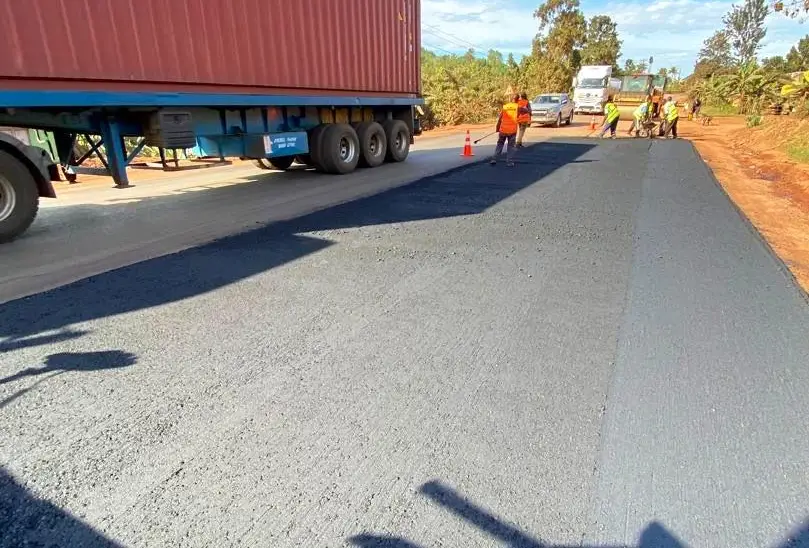
Uganda’s national road network stood at 21,200 kilometres by June 2025, with paved roads accounting for only 6,206.6km, highlighting both the progress made in transport infrastructure and the scale of investment still required to connect communities and unlock economic opportunities.
Uganda Bureau of Statistics (UBOS) tweeted this data on August 19, showing that the country added just 7.6km to its paved national road network during the year to June 2025, from 6,199km in June 2024. Over the same period, the unpaved network declined marginally from 15,001km to 14,993.4km.
The figures offer a mixed picture. Uganda has built an extensive national network, but less than a third of it was paved by June 2025. The numbers also underline why road construction, rehabilitation and maintenance remain central to the government’s economic agenda.
New approach
The road challenge has gained renewed attention under Works and Transport Minister Fred Byamukama, who took over the ministry from Gen Edward Katumba Wamala in June 2026.
While it is too early to make a definitive performance comparison between the two ministers, early indications suggest Byamukama has placed strong emphasis on direct field monitoring, project acceleration and completion of delayed works.
The Ministry of Works and Transport officials said in August that government had intensified field monitoring of road networks in the southern region to improve connectivity and facilitate movement of people and goods. The ministry said the approach is intended to take service delivery closer to citizens by monitoring infrastructure on the ground rather than relying solely on reports.
Byamukama has also intervened directly in delayed projects. On the Kira-Matugga road, for instance, he directed the contractor to accelerate works after expressing concern about slow progress despite a contract extension to July 2027.
He has similarly prioritised stalled projects, with Daily Monitor reporting that the ministry’s FY2026/27 plans include extensive maintenance and efforts to complete projects such as Mubende-Mityana and Mutukula.
Katumba, who headed the ministry before the June 2026 reshuffle, also oversaw major road development and maintenance programmes, but his tenure was increasingly confronted by financing constraints, delayed projects and a growing maintenance backlog. By the 2024/25 financial year, 1,880km of paved roads required periodic maintenance, while another 615km had deteriorated to the point of requiring full rehabilitation, according to figures cited by Daily Monitor.
The distinction, therefore, is less about whether one minister built roads and another did not, and more about emphasis: Byamukama’s early tenure has been marked by visible field inspections, pressure on contractors and a stated focus on completing and maintaining existing projects.
Economic engine
A reliable road network is much more than asphalt. It is the infrastructure through which farmers reach markets, manufacturers obtain raw materials, and workers reach jobs and traders move goods across districts and borders.
The Ministry of Works says the national roads department is responsible for planning, developing, rehabilitating and maintaining national roads to ensure safety, reliability and value for money.
This makes road connectivity central to Uganda’s industrialisation ambitions. A farmer in Kasese, a manufacturer in Kampala or an exporter in Mbarara cannot fully benefit from growing markets if transporting goods remains expensive, slow or unreliable.
Better roads can reduce vehicle operating costs, shorten travel times, improve access to health and education services, stimulate tourism and make rural areas more attractive to investors.
They can also strengthen regional trade by improving links to Kenya’s ports and markets in neighbouring countries. This is particularly important as Uganda seeks to expand exports and position itself as a regional production and logistics hub.
The bigger test
The 21,200km figure should therefore not be read simply as a measure of how many kilometres government has built. The more important question is how much of the network is reliable throughout the year and strategically connected to productive areas.
With only 6,206.6km paved by June 2025, Uganda still faces a substantial infrastructure gap. The marginal increase in paved roads also demonstrates that building new roads alone will not solve the problem.
Government must simultaneously protect existing assets through timely maintenance, finish stalled projects, strengthen contractor supervision and ensure that new roads connect farms, industrial parks, cities, border posts and regional trade corridors.
That is where Byamukama’s approach will ultimately be judged. Frequent inspections and tougher directives may improve accountability, but the real measure of success will be a road network that cuts transport costs, reduces travel time and allows Ugandans to move people and goods efficiently.
For an economy seeking faster industrialisation, the road network is not merely supporting infrastructure. It is the physical platform on which Uganda’s next phase of economic growth will be built.


