KIKUUBE — President Yoweri Museveni has named Uganda’s crude oil “Pearl Sweet”, giving the country’s petroleum a commercial identity as the long-awaited start of oil production draws closer.
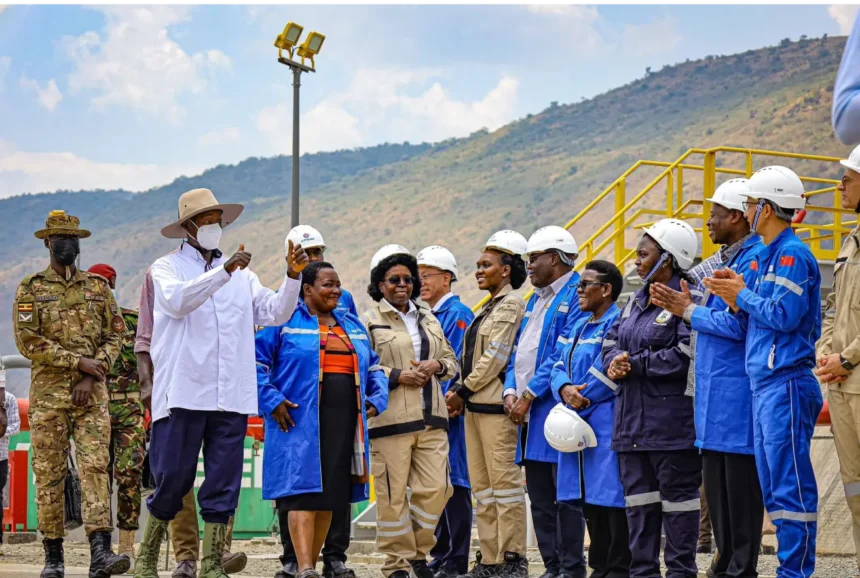
Museveni unveiled the name on Wednesday, September 2, during a visit to the Kingfisher Development Area in Kikuube District, where he inspected progress on the country’s oil and gas projects.
The naming marks a significant moment in Uganda’s petroleum journey, nearly two decades after commercially viable oil was discovered in the Albertine Graben. The name is intended to distinguish Uganda’s crude on international markets, where crude grades are traded under recognisable identities based on their characteristics and origin.
The ceremony comes as government and its partners prepare Uganda for First Oil, expected later this year. Museveni said Uganda’s oil potential could be considerably larger than the resources already confirmed.
“The 6.5 billion barrels of oil that were confirmed only cover 40% of the Lake Albert. We still have 60% to explore,” he said.
The President also praised China’s CNOOC for the speed at which it has advanced the Kingfisher project and challenged other oil partners to accelerate their work. “I want to thank CNOOC here because they have moved very fast. I want the others to also work very fast,” Museveni said.
Bigger oil potential
Uganda’s current petroleum resource base is estimated at about 6.5 billion barrels of oil in place, with roughly 1.4 billion barrels recoverable under current assessments. More recent Petroleum Authority of Uganda data has put oil in place at about 6.65 billion barrels and recoverable resources at 1.65 billion barrels.
Yet only about 40% of the Albertine Graben has been explored, leaving significant potential for additional discoveries. The government is also undertaking exploration work in frontier basins, including Lake Kyoga and Moroto-Kadam.
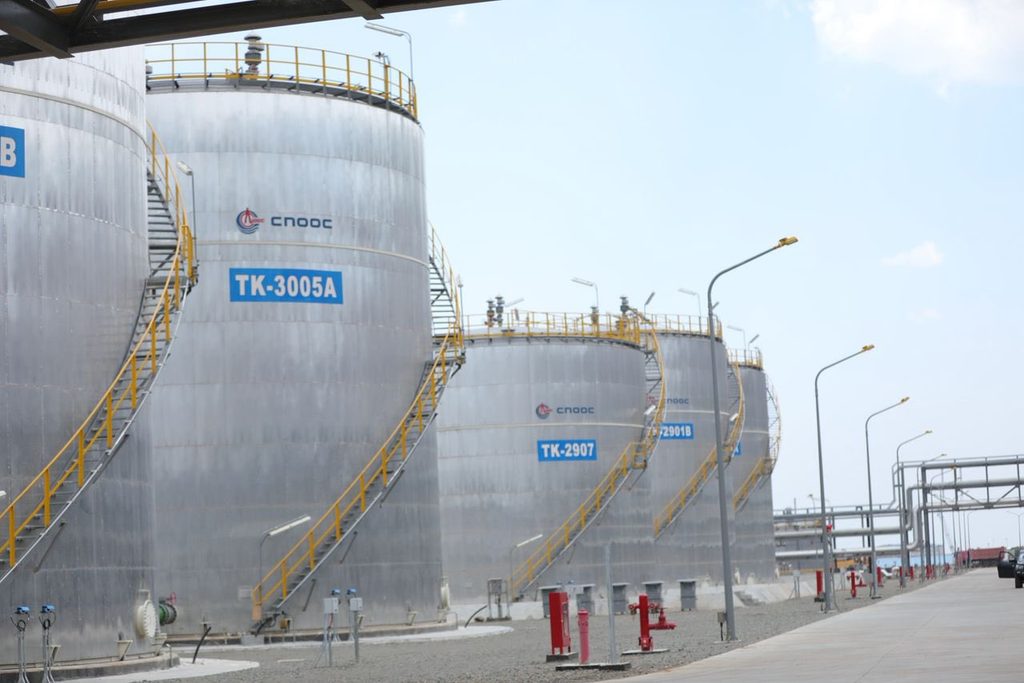
Uganda’s commercial production will initially come from two major developments — Tilenga, operated by TotalEnergies, and Kingfisher, operated by CNOOC Uganda — with the Uganda National Oil Company representing the state’s commercial interests.
At peak production, the two projects are expected to produce about 230,000 barrels of crude oil per day. Kingfisher is designed to contribute about 40,000 barrels per day, while Tilenga is expected to produce about 190,000 barrels per day.
The crude will be transported through the 1,443-kilometre East African Crude Oil Pipeline from the Albertine region to Tanga Port in Tanzania for export to international markets.
The oil industry is expected to significantly change Uganda’s economic outlook. The latest IMF projections put real GDP growth at 6.1% for 2025/26 before accelerating to 8.7% in 2026/27 and 8% in 2027/28 as oil production begins and expands.
The World Bank has a more bullish projection, forecasting Uganda’s economy to grow by 10.4% in financial year 2026/27 as oil production begins, before growth stabilises at around 6%.
The Ministry of Finance has also projected growth above 7% in 2026, rising to about 9% as oil production reaches peak levels. Permanent Secretary and Secretary to the Treasury Ramathan Ggoobi said production is expected to begin in the fourth quarter of 2026 and reach about 230,000 barrels per day around 2028.
This represents a substantial boost compared with Uganda’s recent economic performance. The IMF reported that growth reached 6.3% in the first three quarters of 2025/26.
But government’s ambition extends beyond exporting crude. At Kingfisher, Museveni said Uganda would not flare associated gas but instead use it to generate electricity and produce liquefied petroleum gas for cooking.
“We shall be using the gas to generate electricity, up to 80 megawatts at Kingfisher alone,” he said, adding that the remaining gas would be processed into cooking gas.
The government is also pursuing a 60,000-barrel-per-day refinery at Kabaale in Hoima, intended to supply petroleum products to Uganda and the regional market.
Museveni said domestic refining could save Uganda billions of dollars currently spent importing petroleum products, while reducing transport and transit costs.
Revenue challenge
Oil is also expected to become an increasingly important source of government revenue. The 2026/27 national budget provides for Shs1.44 trillion in petroleum revenue. The IMF projects oil revenues, net of oil-related expenditures, to reach a peak equivalent to 2.8% of GDP in financial year 2032/33 before declining over the longer term.
Finance Minister Henry Musasizi has stressed the need for strong safeguards around petroleum revenues, saying Uganda should use the resource to finance productive investment rather than recurrent consumption.
“We shall manage our impending oil revenues with bulletproof institutional guardrails,” Musasizi has said, arguing that Uganda should become an oil producer without becoming dependent on oil.
Energy and Mineral Development Minister Monica Musenero said Uganda’s petroleum journey was being deliberately integrated with infrastructure, skills development, businesses, refining, transportation and industrialisation.
“Our first priority is first oil,” she said, adding that government and its partners are focused on completing the transition from construction to production safely, efficiently and responsibly.
For CNOOC Uganda, the progress at Kingfisher represents years of investment since it took over operatorship of the project.
CNOOC Uganda President Liu Xiangdong said Museveni’s visit was significant because the progress achieved at Kingfisher represented a shared achievement between Uganda and its partners.
The naming of “Pearl Sweet” therefore comes at a defining point for Uganda. After years of exploration, negotiations, infrastructure development and construction, the country is moving closer to having a crude grade that can be identified, marketed and traded internationally.
The bigger test, however, will be whether the oil wealth can translate into productive investment, jobs, industrialisation and improved living standards while protecting Uganda’s economy from the risks associated with dependence on a finite resource.
The IMF has specifically urged Uganda to establish a robust and transparent framework for managing oil revenues and safeguarding intergenerational equity.